Training - Kotlin
Published on 12 May 2022
Mind map
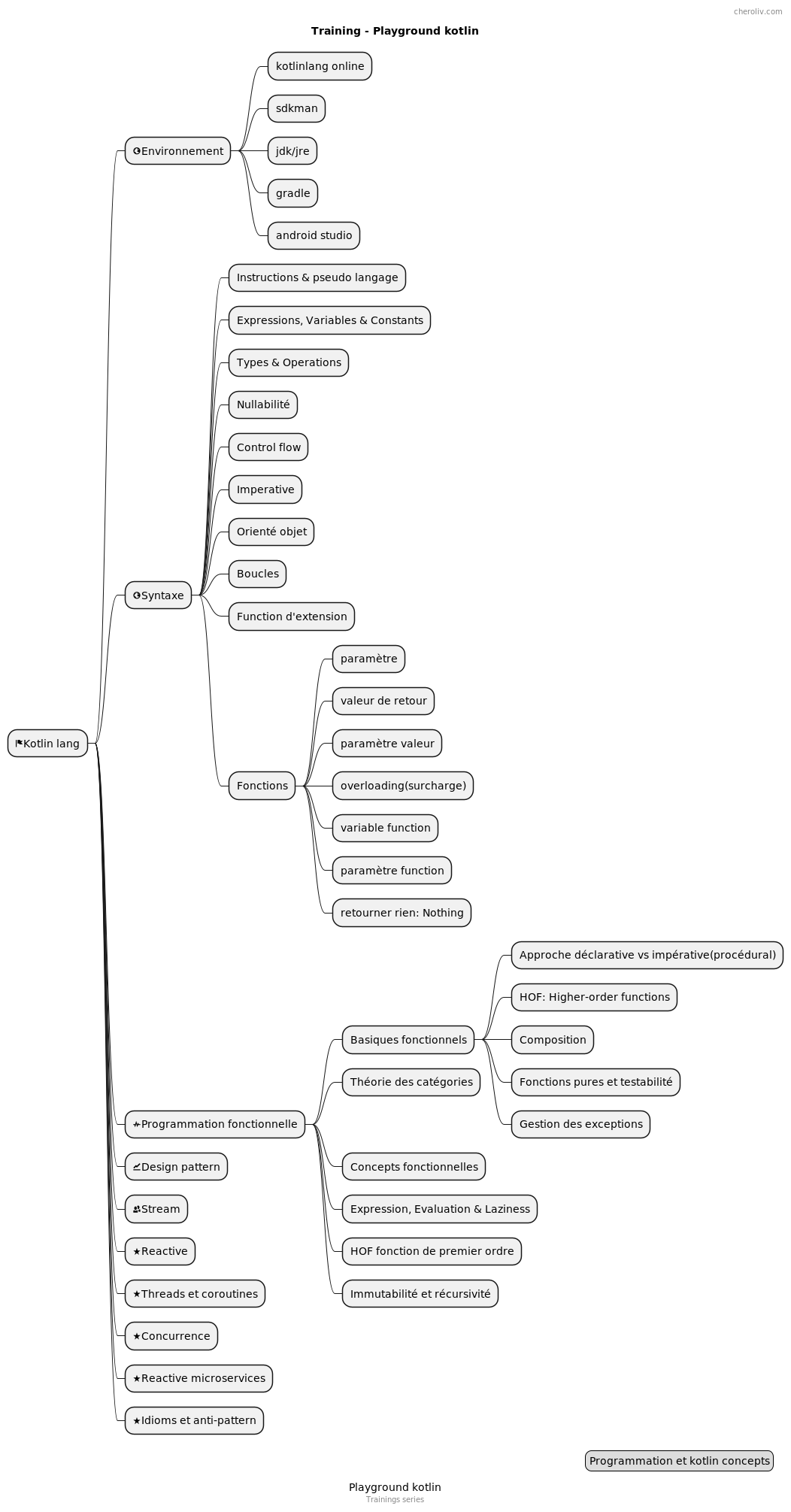
Functional programming
The exercises are taken from the book:
Functional programing in kotlin by tutorials
Written by Massimo Carli
repo: https://github.com/kodecocodes/fpk-materials
Syntax
FirstProgramTest
notions: screen display, function
FirstProgramTest:https://github.com/cheroliv/cheroliv.com/blob/master/codes/src/test/kotlin/programming/FirstProgramTest.kt[source]+
ConcatFunctionTest
concepts: memory, variable, value, object, function extension
ExampleUnitTest:https://github.com/cheroliv/cheroliv.com/blob/master/codes/src/test/kotlin/programming/ConcatFunctionTest.kt[source]+
BirthdayMessageTestOutput
notions: sets, loops
Introduction to kotlin
BirthdayMessageTestOutput:https://github.com/cheroliv/cheroliv.com/blob/master/codes/src/test/kotlin/programming/BirthdayMessageTestOutput.kt[source]+
Kotlin course
Functional basics
Declarative X imperative approach
package functional

import kotlin.test.Test
import kotlin.test.assertEquals

class DeclarativeTests {
    val input = listOf(
        "123", "abc", "1ds", "987", "abdf", "1d3", "de1", "88", "101"
    )

    fun imperativeSum(list: List<String>): Int {
        var sum = 0
        for (item in list) {
            try {
                sum += item.toInt()
            } catch (_: NumberFormatException) {
            }
        }
        return sum
    }

    @Test
    fun `test imperative approach`() {
        imperativeSum(input).run {
            println("Sum $this")
            assertEquals(1299, this)
        }
    }

    fun isValidNumber(s: String) = try {
        s.toInt()
        true
    } catch (_: NumberFormatException) {
        false
    }

    fun declarativeSum(list: List<String>) = list
        .filter(::isValidNumber)
        .map(String::toInt)
        .sum()

    @Test
    fun `test declarative approach`() {
        assertEquals(1299, declarativeSum(input).apply {
            println("Sum $this")
        })
    }
}
Exercise 1.1
Implement the sumInRange function, which adds up the values in
a List<String> in a given interval. The signature is:
fun sumInRange(input: List<String>, range: IntRange): Int@Test
fun `Exercise 1_1`() {
assertEquals(4, sumInRange(
listOf("1", "10", "a", "7", "ad2", "3"),
1..5
).apply { println("sumInRange 1..5: $this") }
)
}Try it and check your answer with thehttps://github.com/cheroliv/cheroliv.com/blob/master/codes/src/test/kotlin/functional/DeclarativeTests.kt[solution, windows="_blank].
Higher-order functions
package functional

import java.io.ByteArrayOutputStream
import java.io.PrintStream
import java.lang.System.*
import java.lang.Thread.sleep
import kotlin.math.sign
import kotlin.test.Test
import kotlin.test.assertEquals

class BasicsHOFTests {
    val ONE_SECOND = 1000L

    @Test
    fun `high order function`() {
        //capture de la sortie standard
        val standardOut: PrintStream? = out
        val outputStreamCaptor = ByteArrayOutputStream()
        setOut(PrintStream(outputStreamCaptor))

        3.times { println("Hello") }
        assertEquals(
            buildString {
                repeat(3) { append("Hello\n") }
                deleteAt(length - 1)
            }, outputStreamCaptor
                .toString()
                .trim()
        )

        //libération de la sortie standard
        setOut(standardOut)
    }

    fun Int.times1(fn: () -> Unit) {
        for (i in 1..this) {
            fn()
        }
    }

    fun Int.times2(fn: () -> Unit) {
        for (i in 1..this) fn()
    }

    fun Int.times3(fn: () -> Unit) =
        (1..this).forEach { fn() }


    fun Int.times4(fn: () -> Unit) =
        repeat((1..this).count()) { fn() }

    fun Int.times(fn: () -> Unit) =
        (1..this).forEach { _ -> fn() }
}
Exercise 1.2
Implement chrono, which accepts a function of type`() →`
Unit as input and returns the time spent executing it. The signature is:
fun chrono(fn : () -> Unité) : Long@Test
fun `Exercise 1_2`() {
val waitOneSec = { sleep(ONE_SECOND) }
chrono(waitOneSec).apply {
println("chrono: $this")
assertEquals(1, sign)
}
}Try it and check your answer with thehttps://github.com/cheroliv/cheroliv.com/blob/master/codes/src/test/kotlin/functional/BasicsHOFTests.kt[solution, windows="_blank].
Composition
package functional

import kotlin.test.Test
import kotlin.test.assertEquals


fun double(x: Int): Int = 2 * x
fun square(x: Int): Int = x * x
fun squareAndDouble1(x: Int) = double(square(x))

infix fun <A, B, C> ((A) -> B).compose(g: (B) -> C)
        : (A) -> C = { a -> g(this(a)) }

class CompositionTests {
    @Test
    fun composition_impure() {
        assertEquals(200, double(square(10)))
        assertEquals(200, squareAndDouble1(10))
    }

    @Test
    fun composition_pure() {
        val squareAndDouble = ::square compose ::double
        assertEquals(200, squareAndDouble(10))
    }

}
Pure functions and testability
package functional

import java.io.ByteArrayOutputStream
import java.io.PrintStream
import java.lang.System.out
import java.lang.System.setOut
import kotlin.test.Test
import kotlin.test.assertEquals


var count = 0

//impure car une variable global subit un effet de bord
fun impure(value: Int): Int {
    count++
    return value + count
}

//impure car utilisation de la sortie standard qui fait muter le system
fun addOneAndLog(x: Int): Int {
    val result = x + 1
    println("New Value is $result")
    return result
}

//pure
fun addOne(x: Int) = (x + 1).run {
    Pair(this, "New Value is $this")
}

class PureTests {
    @Test
    fun `impure fonction`() {
        assertEquals(3, impure(2))

        val standardOut = out
        val outputStreamCaptor = ByteArrayOutputStream()
        setOut(PrintStream(outputStreamCaptor))

        addOneAndLog(3)

        assertEquals(
            "New Value is 4",
            outputStreamCaptor
                .toString()
                .trim()
        )
        setOut(standardOut)
    }

    @Test
    fun `pure fonction`() {
        addOne(3).run {
            assertEquals(4, first)
            assertEquals("New Value is 4", second)
        }
    }
}
Exception handling
package functional

import org.junit.jupiter.api.assertThrows
import kotlin.Result.Companion.failure
import kotlin.Result.Companion.success
import kotlin.test.Test
import kotlin.test.assertEquals

//NumberFormatException est un effet de bord qui rend la fonction impure
fun strToInt(str: String) = str.toInt()

//pure
fun strToIntOrNull(str: String) = try {
    str.toInt()
} catch (nfe: NumberFormatException) {
    null
}

//pure avec gestion de l'exception plus élégante
fun strToIntResult(str: String): Result<Int> =
    try {
        success(str.toInt())
    } catch (nfe: NumberFormatException) {
        failure(nfe)
    }

class ExceptionHandlingTests {
    @Test
    fun impure() {
        assertThrows<NumberFormatException> { strToInt("foo") }
        assertEquals(1, strToInt("1"))
    }

    @Test
    fun pure() {
        assertEquals(null, strToIntOrNull("foo"))
        assertEquals(1, strToIntOrNull("1"))
    }

    @Test
    fun `pure avec result`() {
        assertEquals(1, strToIntResult("1").getOrNull())
        assertEquals(
            "For input string: \"foo\"",
            strToIntResult("foo")
                .exceptionOrNull()
                ?.message
        )
    }
}
Key points
-
While object-oriented programming means programming with objects,
functional programming means programming with functions. You break down a problem into several sub-problems, which you model with the functions.
-
Higher-order functions accept other functions as input or return other
function as return values. Category theory is the theory of composition, and you use it to understand how to compose your functions in a work program. The output value of a pure function depends only on its input parameters, and it has no side effects.
-
A side effect is something that a function does to the outside world. This
may be a log to standard output or the modification of a global variable’s value. Functional programming works for pure functions, but it also provides the tools to transform impure functions into pure functions. You can make an impure function pure by moving the effects to make them part of the return value
-
Functional programming is a matter of composition.
Error handling is a typical case of side effects, and Kotlin gives you the tools to manage them in a functional manner.
Deepening Java 8: lambda expressions and functional interfaces
Category theory
The mathematical theory of categories:
Fundamentals of functions
Exercise 2.1
Can you write an example of a function mapping distinct values
whose domain maps to non-distinct values in the range, such as f(b) and f(c) in the figure below?
Try it, then check the challenge project for a solution to see how you did.
You will find advice and an explanation by following the link to the solution.
Exercise 2.2
Can you write the inverse function of twice?
What are the domain and range for the inverse function?
Check out the challenge project and Appendix B for the solution.
fun chrono(fn : () -> Unité) : Long@Test
fun `Exercise 1_2`() {
val waitOneSec = { sleep(ONE_SECOND) }
chrono(waitOneSec).apply {
println("chrono: $this")
assertEquals(1, sign)
}
}Try it and check your answer with thehttps://github.com/cheroliv/cheroliv.com/blob/master/codes/src/test/kotlin/functional/BasicsHOFTests.kt[solution, windows="_blank].