�培训 - Kotlin
Publié le 12 May 2022
思维导图
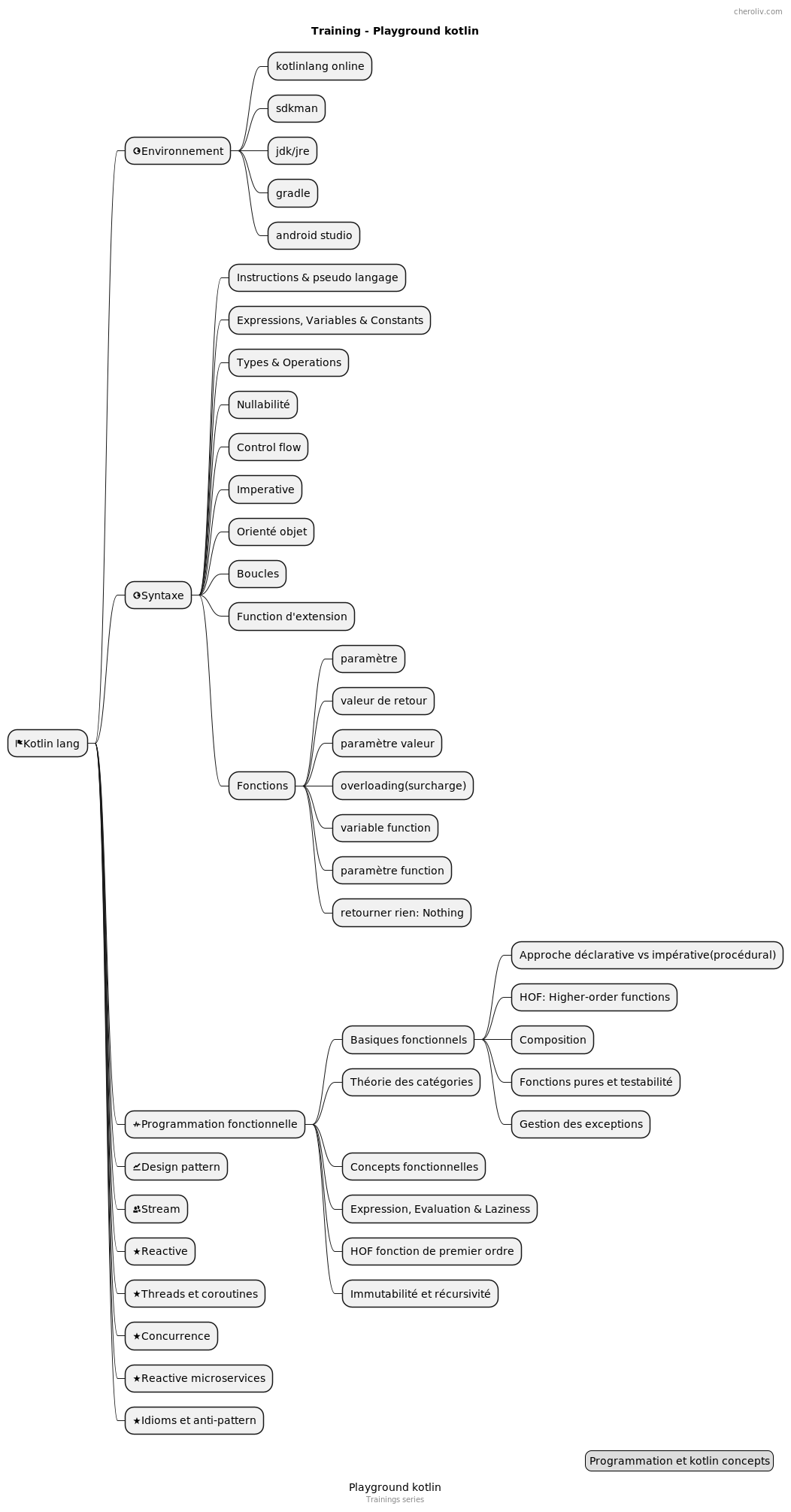
�函数式编程
这些练习摘自这本书:
通过教程学习Kotlin中的函数式编程
由 Massimo Carli 编写
仓库: https://github.com/kodecocodes/fpk-materials
语法
FirstProgramTest
概念:显示屏, 功能
第一个程序测试:https://github.com/cheroliv/cheroliv.com/blob/master/codes/src/test/kotlin/programming/FirstProgramTest.kt[来源]+
连接函数测试
notions: 内存, 变量, 值, 对象, 函数扩展
ExampleUnitTest: (No text to translate – produce an empty response.)+
生日消息测试输出
概念: 集合, 循环
kotlin介绍
BirthdayMessageTestOutputhttps://github.com/cheroliv/cheroliv.com/blob/master/codes/src/test/kotlin/programming/BirthdayMessageTestOutput.kt[来源]+
Kotlin 课程
基本功能
声明式 X 命令式 方法
package functional

import kotlin.test.Test
import kotlin.test.assertEquals

class DeclarativeTests {
    val input = listOf(
        "123", "abc", "1ds", "987", "abdf", "1d3", "de1", "88", "101"
    )

    fun imperativeSum(list: List<String>): Int {
        var sum = 0
        for (item in list) {
            try {
                sum += item.toInt()
            } catch (_: NumberFormatException) {
            }
        }
        return sum
    }

    @Test
    fun `test imperative approach`() {
        imperativeSum(input).run {
            println("Sum $this")
            assertEquals(1299, this)
        }
    }

    fun isValidNumber(s: String) = try {
        s.toInt()
        true
    } catch (_: NumberFormatException) {
        false
    }

    fun declarativeSum(list: List<String>) = list
        .filter(::isValidNumber)
        .map(String::toInt)
        .sum()

    @Test
    fun `test declarative approach`() {
        assertEquals(1299, declarativeSum(input).apply {
            println("Sum $this")
        })
    }
}
练习 1.1
实现函数 sumInRange,该函数在其中对值求和
一个 List<String> 在给定区间内。签名是:
fun sumInRange(input: List<String>, range: IntRange): Int@Test
fun `Exercise 1_1`() {
assertEquals(4, sumInRange(
listOf("1", "10", "a", "7", "ad2", "3"),
1..5
).apply { println("sumInRange 1..5: $this") }
)
}试试看,并用……检查你的答案https://github.com/cheroliv/cheroliv.com/blob/master/codes/src/test/kotlin/functional/DeclarativeTests.kt[解决方案, windows="_blank]。
高阶函数
package functional

import java.io.ByteArrayOutputStream
import java.io.PrintStream
import java.lang.System.*
import java.lang.Thread.sleep
import kotlin.math.sign
import kotlin.test.Test
import kotlin.test.assertEquals

class BasicsHOFTests {
    val ONE_SECOND = 1000L

    @Test
    fun `high order function`() {
        //capture de la sortie standard
        val standardOut: PrintStream? = out
        val outputStreamCaptor = ByteArrayOutputStream()
        setOut(PrintStream(outputStreamCaptor))

        3.times { println("Hello") }
        assertEquals(
            buildString {
                repeat(3) { append("Hello\n") }
                deleteAt(length - 1)
            }, outputStreamCaptor
                .toString()
                .trim()
        )

        //libération de la sortie standard
        setOut(standardOut)
    }

    fun Int.times1(fn: () -> Unit) {
        for (i in 1..this) {
            fn()
        }
    }

    fun Int.times2(fn: () -> Unit) {
        for (i in 1..this) fn()
    }

    fun Int.times3(fn: () -> Unit) =
        (1..this).forEach { fn() }


    fun Int.times4(fn: () -> Unit) =
        repeat((1..this).count()) { fn() }

    fun Int.times(fn: () -> Unit) =
        (1..this).forEach { _ -> fn() }
}
练习 1.2
实现chrono,它接受一个类型为的函数`() →`
单元接收输入并返回执行它所花费的时间。其签名是:
fun chrono(fn : () -> Unité) : Long@Test
fun `Exercise 1_2`() {
val waitOneSec = { sleep(ONE_SECOND) }
chrono(waitOneSec).apply {
println("chrono: $this")
assertEquals(1, sign)
}
}试一下它,并用它检查你的答案https://github.com/cheroliv/cheroliv.com/blob/master/codes/src/test/kotlin/functional/BasicsHOFTests.kt[solution, windows="_blank].
构成
package functional

import kotlin.test.Test
import kotlin.test.assertEquals


fun double(x: Int): Int = 2 * x
fun square(x: Int): Int = x * x
fun squareAndDouble1(x: Int) = double(square(x))

infix fun <A, B, C> ((A) -> B).compose(g: (B) -> C)
        : (A) -> C = { a -> g(this(a)) }

class CompositionTests {
    @Test
    fun composition_impure() {
        assertEquals(200, double(square(10)))
        assertEquals(200, squareAndDouble1(10))
    }

    @Test
    fun composition_pure() {
        val squareAndDouble = ::square compose ::double
        assertEquals(200, squareAndDouble(10))
    }

}
纯函数和可测试性
package functional

import java.io.ByteArrayOutputStream
import java.io.PrintStream
import java.lang.System.out
import java.lang.System.setOut
import kotlin.test.Test
import kotlin.test.assertEquals


var count = 0

//impure car une variable global subit un effet de bord
fun impure(value: Int): Int {
    count++
    return value + count
}

//impure car utilisation de la sortie standard qui fait muter le system
fun addOneAndLog(x: Int): Int {
    val result = x + 1
    println("New Value is $result")
    return result
}

//pure
fun addOne(x: Int) = (x + 1).run {
    Pair(this, "New Value is $this")
}

class PureTests {
    @Test
    fun `impure fonction`() {
        assertEquals(3, impure(2))

        val standardOut = out
        val outputStreamCaptor = ByteArrayOutputStream()
        setOut(PrintStream(outputStreamCaptor))

        addOneAndLog(3)

        assertEquals(
            "New Value is 4",
            outputStreamCaptor
                .toString()
                .trim()
        )
        setOut(standardOut)
    }

    @Test
    fun `pure fonction`() {
        addOne(3).run {
            assertEquals(4, first)
            assertEquals("New Value is 4", second)
        }
    }
}
异常处理
package functional

import org.junit.jupiter.api.assertThrows
import kotlin.Result.Companion.failure
import kotlin.Result.Companion.success
import kotlin.test.Test
import kotlin.test.assertEquals

//NumberFormatException est un effet de bord qui rend la fonction impure
fun strToInt(str: String) = str.toInt()

//pure
fun strToIntOrNull(str: String) = try {
    str.toInt()
} catch (nfe: NumberFormatException) {
    null
}

//pure avec gestion de l'exception plus élégante
fun strToIntResult(str: String): Result<Int> =
    try {
        success(str.toInt())
    } catch (nfe: NumberFormatException) {
        failure(nfe)
    }

class ExceptionHandlingTests {
    @Test
    fun impure() {
        assertThrows<NumberFormatException> { strToInt("foo") }
        assertEquals(1, strToInt("1"))
    }

    @Test
    fun pure() {
        assertEquals(null, strToIntOrNull("foo"))
        assertEquals(1, strToIntOrNull("1"))
    }

    @Test
    fun `pure avec result`() {
        assertEquals(1, strToIntResult("1").getOrNull())
        assertEquals(
            "For input string: \"foo\"",
            strToIntResult("foo")
                .exceptionOrNull()
                ?.message
        )
    }
}
关键点
-
虽然面向对象编程意味着用对象进行编程,
函数式编程意味着用函数进行编程。 你将一个问题分解为多个子问题,并对它们建模 函数。
-
高阶函数接受其他函数作为输入或返回其他
它们像返回值一样工作。 范畴论是组合的理论,你用它来理解 如何在工作程序中组合你的函数。 纯函数的输出值仅依赖于其输入参数,并且它 没有副作用。
-
副作用是指函数对外部世界所做的事情。这
可以是标准输出中的一个日志,或者修改全局变量的值。 �函数式编程对纯函数有效,但它也提供了 用于将不纯函数转换为纯函数的工具。 您可以通过移动副作用来使一个不纯函数变为纯函数 返回值的一部分。
-
�函数式编程是关于组合的问题。
错误处理是副作用的典型情况,而 Kotlin 为你提供了工具 以功能性的方式进行管理。
深入了解 java8:Lambda 表达式和函数式接口
范畴理论
数学范畴理论:
�函数的基础
练习 2.1
您能写一个映射不同值的函数示例吗?
其域映射到值域中不相离的值,例如下图中的 f(b) 和 f(c) ?
试试看,然后查看挑战项目的解决方案,看看你做得怎么样。
您将在以下链接中找到建议和解释 解决方案,windows="_blank。
练习 2.2
您能写出 twice 的逆函数吗?
逆函数的定义域和值域是什么?
查看挑战项目和附录B以获取解决方案。
fun chrono(fn : () -> Unité) : Long@Test
fun `Exercise 1_2`() {
val waitOneSec = { sleep(ONE_SECOND) }
chrono(waitOneSec).apply {
println("chrono: $this")
assertEquals(1, sign)
}
}试试看并检查您的答案与该https://github.com/cheroliv/cheroliv.com/blob/master/codes/src/test/kotlin/functional/BasicsHOFTests.kt[解决方案, windows="_blank].