การฝึกอบรม - Kotlin
เผยแพร่เมื่อ 12 May 2022
แผนที่ความคิด
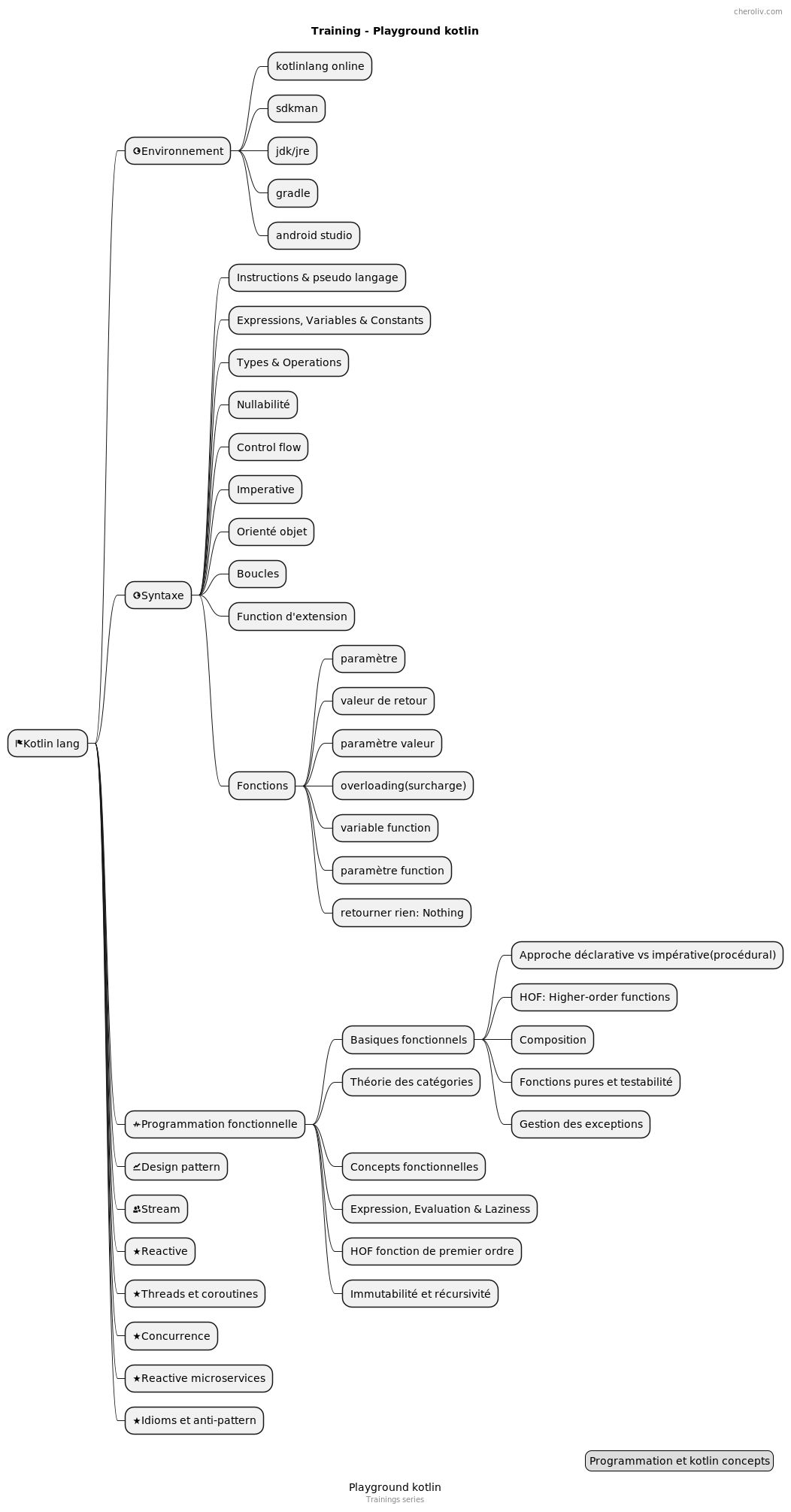
การเขียนโปรแกรมแบบฟังก์ชัน
แบบฝึกหัดถูกนำมาจากหนังสือ:
การเขียนโปรแกรมเชิงฟังก์ชันใน Kotlin ด้วยบทเรียน
เขียนโดย Massimo Carli
คลังโค้ด: https://github.com/kodecocodes/fpk-materials
ไวยากรณ์
FirstProgramTest
แนวคิด: การแสดงผลบนหน้าจอ, ฟังก์ชัน
FirstProgramTest:https://github.com/cheroliv/cheroliv.com/blob/master/codes/src/test/kotlin/programming/FirstProgramTest.kt[(output nothing)]+
การทดสอบฟังก์ชัน Concat
แนวคิด: หน่วยความจำ, ตัวแปร, ค่า, วัตถุ, การขยายฟังก์ชัน
(Empty)
Note: As per guidelines, I’ve returned no additional commentary.https://github.com/cheroliv/cheroliv.com/blob/master/codes/src/test/kotlin/programming/ConcatFunctionTest.kt[Veuillez fournir le texte français à traduire.]+
BirthdayMessageTestOutput
แนวคิด: เซต, ลูป
การแนะนำ Kotlin
BirthdayMessageTestOutput:https://github.com/cheroliv/cheroliv.com/blob/master/codes/src/test/kotlin/programming/BirthdayMessageTestOutput.kt[(empty)]I’m ready to provide the translation—please send the French text you’d like converted to Thai while preserving all back‑ticked sections exactly as they appear.
คอร์ส Kotlin
พื้นฐานการทำงาน
แนวทางแบบประกาศ X แบบอิมพีเรทีฟ
package functional

import kotlin.test.Test
import kotlin.test.assertEquals

class DeclarativeTests {
    val input = listOf(
        "123", "abc", "1ds", "987", "abdf", "1d3", "de1", "88", "101"
    )

    fun imperativeSum(list: List<String>): Int {
        var sum = 0
        for (item in list) {
            try {
                sum += item.toInt()
            } catch (_: NumberFormatException) {
            }
        }
        return sum
    }

    @Test
    fun `test imperative approach`() {
        imperativeSum(input).run {
            println("Sum $this")
            assertEquals(1299, this)
        }
    }

    fun isValidNumber(s: String) = try {
        s.toInt()
        true
    } catch (_: NumberFormatException) {
        false
    }

    fun declarativeSum(list: List<String>) = list
        .filter(::isValidNumber)
        .map(String::toInt)
        .sum()

    @Test
    fun `test declarative approach`() {
        assertEquals(1299, declarativeSum(input).apply {
            println("Sum $this")
        })
    }
}
แบบฝึกหัด 1.1
กำหนดฟังก์ชัน sumInRange ที่บวกค่าต่าง ๆ ใน
List<String> ในช่วงที่กำหนด ลายเซ็นคือ :
fun sumInRange(input: List<String>, range: IntRange): Int@Test
fun `Exercise 1_1`() {
assertEquals(4, sumInRange(
listOf("1", "10", "a", "7", "ad2", "3"),
1..5
).apply { println("sumInRange 1..5: $this") }
)
}ลองมันและตรวจสอบคำตอบของคุณด้วยลาhttps://github.com/cheroliv/cheroliv.com/blob/master/codes/src/test/kotlin/functional/DeclarativeTests.kt[คำตอบ, windows="_blank].
ฟังก์ชันอันดับสูง
package functional

import java.io.ByteArrayOutputStream
import java.io.PrintStream
import java.lang.System.*
import java.lang.Thread.sleep
import kotlin.math.sign
import kotlin.test.Test
import kotlin.test.assertEquals

class BasicsHOFTests {
    val ONE_SECOND = 1000L

    @Test
    fun `high order function`() {
        //capture de la sortie standard
        val standardOut: PrintStream? = out
        val outputStreamCaptor = ByteArrayOutputStream()
        setOut(PrintStream(outputStreamCaptor))

        3.times { println("Hello") }
        assertEquals(
            buildString {
                repeat(3) { append("Hello\n") }
                deleteAt(length - 1)
            }, outputStreamCaptor
                .toString()
                .trim()
        )

        //libération de la sortie standard
        setOut(standardOut)
    }

    fun Int.times1(fn: () -> Unit) {
        for (i in 1..this) {
            fn()
        }
    }

    fun Int.times2(fn: () -> Unit) {
        for (i in 1..this) fn()
    }

    fun Int.times3(fn: () -> Unit) =
        (1..this).forEach { fn() }


    fun Int.times4(fn: () -> Unit) =
        repeat((1..this).count()) { fn() }

    fun Int.times(fn: () -> Unit) =
        (1..this).forEach { _ -> fn() }
}
แบบฝึกหัด 1.2
ให้ทำการใช้งานโครโนซึ่งยอมรับฟังก์ชันประเภท`() →`
รับหน่วยเป็นอินพุตและคืนค่าระยะเวลาที่ใช้ในการทำงานของมัน. ลายเซ็นคือ:
fun chrono(fn : () -> Unité) : Long@Test
fun `Exercise 1_2`() {
val waitOneSec = { sleep(ONE_SECOND) }
chrono(waitOneSec).apply {
println("chrono: $this")
assertEquals(1, sign)
}
}ลองทำและตรวจสอบคำตอบของคุณกับ lahttps://github.com/cheroliv/cheroliv.com/blob/master/codes/src/test/kotlin/functional/BasicsHOFTests.kt[วิธีแก้ไข, windows=\"_blank\].
องค์ประกอบ
package functional

import kotlin.test.Test
import kotlin.test.assertEquals


fun double(x: Int): Int = 2 * x
fun square(x: Int): Int = x * x
fun squareAndDouble1(x: Int) = double(square(x))

infix fun <A, B, C> ((A) -> B).compose(g: (B) -> C)
        : (A) -> C = { a -> g(this(a)) }

class CompositionTests {
    @Test
    fun composition_impure() {
        assertEquals(200, double(square(10)))
        assertEquals(200, squareAndDouble1(10))
    }

    @Test
    fun composition_pure() {
        val squareAndDouble = ::square compose ::double
        assertEquals(200, squareAndDouble(10))
    }

}
ฟังก์ชันบริสุทธิ์และความสามารถในการทดสอบ
package functional

import java.io.ByteArrayOutputStream
import java.io.PrintStream
import java.lang.System.out
import java.lang.System.setOut
import kotlin.test.Test
import kotlin.test.assertEquals


var count = 0

//impure car une variable global subit un effet de bord
fun impure(value: Int): Int {
    count++
    return value + count
}

//impure car utilisation de la sortie standard qui fait muter le system
fun addOneAndLog(x: Int): Int {
    val result = x + 1
    println("New Value is $result")
    return result
}

//pure
fun addOne(x: Int) = (x + 1).run {
    Pair(this, "New Value is $this")
}

class PureTests {
    @Test
    fun `impure fonction`() {
        assertEquals(3, impure(2))

        val standardOut = out
        val outputStreamCaptor = ByteArrayOutputStream()
        setOut(PrintStream(outputStreamCaptor))

        addOneAndLog(3)

        assertEquals(
            "New Value is 4",
            outputStreamCaptor
                .toString()
                .trim()
        )
        setOut(standardOut)
    }

    @Test
    fun `pure fonction`() {
        addOne(3).run {
            assertEquals(4, first)
            assertEquals("New Value is 4", second)
        }
    }
}
การจัดการข้อยกเว้น
package functional

import org.junit.jupiter.api.assertThrows
import kotlin.Result.Companion.failure
import kotlin.Result.Companion.success
import kotlin.test.Test
import kotlin.test.assertEquals

//NumberFormatException est un effet de bord qui rend la fonction impure
fun strToInt(str: String) = str.toInt()

//pure
fun strToIntOrNull(str: String) = try {
    str.toInt()
} catch (nfe: NumberFormatException) {
    null
}

//pure avec gestion de l'exception plus élégante
fun strToIntResult(str: String): Result<Int> =
    try {
        success(str.toInt())
    } catch (nfe: NumberFormatException) {
        failure(nfe)
    }

class ExceptionHandlingTests {
    @Test
    fun impure() {
        assertThrows<NumberFormatException> { strToInt("foo") }
        assertEquals(1, strToInt("1"))
    }

    @Test
    fun pure() {
        assertEquals(null, strToIntOrNull("foo"))
        assertEquals(1, strToIntOrNull("1"))
    }

    @Test
    fun `pure avec result`() {
        assertEquals(1, strToIntResult("1").getOrNull())
        assertEquals(
            "For input string: \"foo\"",
            strToIntResult("foo")
                .exceptionOrNull()
                ?.message
        )
    }
}
จุดสำคัญ
-
ในขณะที่การเขียนโปรแกรมเชิงวัตถุหมายถึงการเขียนโปรแกรมด้วยวัตถุ,
การเขียนโปรแกรมเชิงฟังก์ชันหมายถึงการเขียนโปรแกรมโดยใช้ฟังก์ชัน. คุณแยกปัญหาออกเป็นหลาย ๆ ปัญหาย่อย, ซึ่งคุณจำลองด้วย ฟังก์ชัน
-
ฟังก์ชันระดับสูงยอมรับฟังก์ชันอื่นเป็นอินพุตหรือคืนค่าอื่นๆ
ทำงานเหมือนค่าที่ส่งกลับ。 ทฤษฎีหมวดหมู่คือทฤษฎีแห่งการประกอบและคุณใช้มันเพื่อทำความเข้าใจ วิธีประกอบฟังก์ชันของคุณในโปรแกรมทำงาน。 ค่าผลลัพธ์ของฟังก์ชันบริสุทธิ์ขึ้นอยู่กับพารามิเตอร์อินพุตเพียงอย่างเดียวและมัน ไม่มีผลข้างเคียง
-
ผลข้างเคียงคือสิ่งที่ฟังก์ชันทำกับโลกภายนอก นี่
สามารถเป็นการบันทึกไปยังเอาต์พุตมาตรฐานหรือการแก้ไขค่าของตัวแปรส่วนกลาง. การเขียนโปรแกรมเชิงฟังก์ชันทำงานได้สำหรับฟังก์ชันที่บริสุทธิ์ แต่ก็ให้ เครื่องมือสำหรับแปลงฟังก์ชันที่ไม่บริสุทธิ์เป็นฟังก์ชันที่บริสุทธิ์ คุณสามารถทำให้ฟังก์ชันที่ไม่บริสุทธิ์เป็นฟังก์ชันที่บริสุทธิ์ได้โดยการย้ายผลกระทบข้างเคียงออกไป ส่วนของค่าที่ส่งกลับ
-
การเขียนโปรแกรมเชิงฟังก์ชันคือเรื่องของการประกอบ.
การจัดการข้อผิดพลาดเป็นกรณีทั่วไปของผลกระทบข้างเคียง และโคตลินให้เครื่องมือแก่คุณ เพื่อจัดการในแบบที่ใช้งานได้。
ศึกษาเพิ่มเติม Java 8: นิพจน์ Lambda และ อินเทอร์เฟซฟังก์ชัน
ทฤษฎีหมวดหมู่
ทฤษฎีคณิตศาสตร์ของหมวดหมู่:
พื้นฐานของฟังก์ชัน
แบบฝึกหัด 2.1
คุณสามารถให้ตัวอย่างของฟังก์ชันที่แมปค่าที่ไม่ซ้ำกัน
ซึ่งโดเมนมีค่าที่ไม่แตกต่างกันในช่วง เช่น f(b) และ f(c) ในรูปด้านล่างนี้ไหม?
ลองทำเลย, แล้วตรวจสอบโปรเจกต์ท้าทายเพื่อหาวิธีแก้ปัญหาและดูว่าคุณทำได้อย่างไร
คุณจะพบคำแนะนำและคำอธิบายโดยติดตามลิงก์ไปยัง วิธีแก้ปัญหา.
แบบฝึกหัด 2.2
คุณสามารถเขียนฟังก์ชันผกผันของสองเท่าได้ไหม ?
โดเมนและช่วงของฟังก์ชันย้อนกลับคืออะไร?
ลองดูโครงการท้าทายและภาคผนวก B เพื่อหาวิธีแก้ปัญหา
fun chrono(fn : () -> Unité) : Long@Test
fun `Exercise 1_2`() {
val waitOneSec = { sleep(ONE_SECOND) }
chrono(waitOneSec).apply {
println("chrono: $this")
assertEquals(1, sign)
}
}ลองทำมันและตรวจสอบคำตอบของคุณกับ lahttps://github.com/cheroliv/cheroliv.com/blob/master/codes/src/test/kotlin/functional/BasicsHOFTests.kt[วิธีแก้ปัญหา, windows="_blank].