Teil 2: Industrialisieren und sichern Sie eine erweiterte Python-CI/CD-Pipeline
Publié le 18 July 2025
- Einführung
- Architektur des CI/CD-Pipelines
- Projektstruktur
- Konfiguration des Pakets mit pyproject.toml
- CI/CD-Workflow - Tests und Qualität
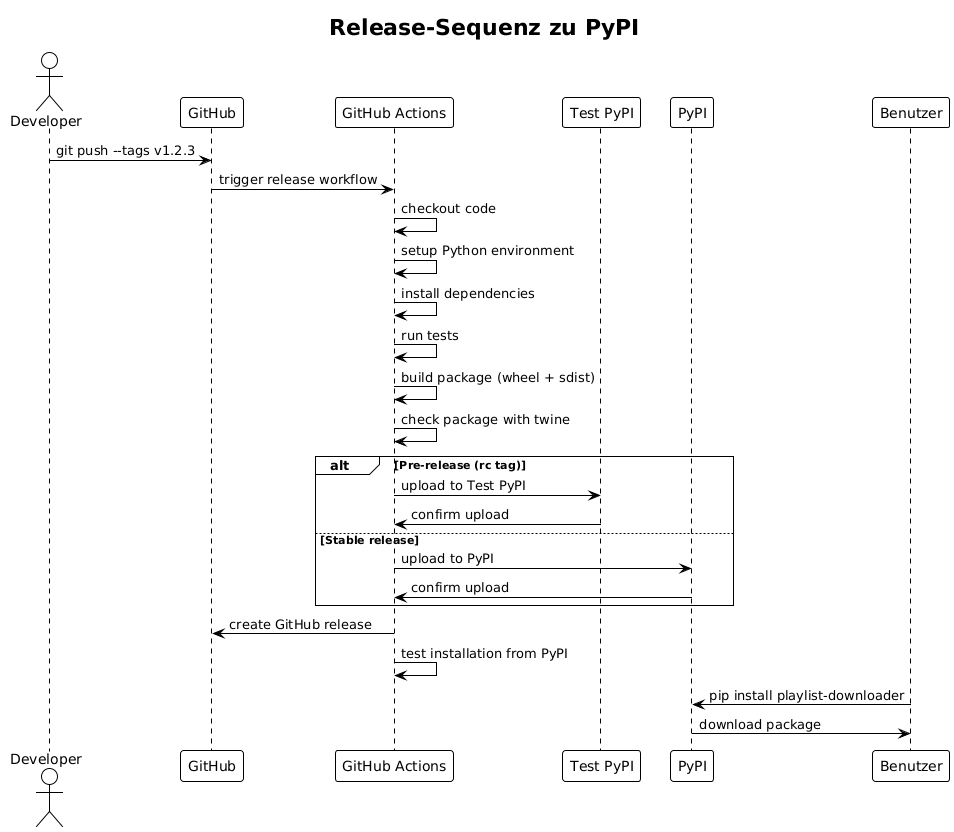
- Release- und Deployments-Workflow
- Diagramme der Architektur
- Objekte und Modelle der Pipeline
- Konfiguration der Geheimnisse
- Lokale Entwicklungs-Skripte
- Gute Praktiken und Empfehlungen
- Monitoring und Observabilität
- Fazit
- Zusatzressourcen
Einführung
Im ersten Teil dieser Serie haben wir eine einfache, aber wirksame CI/CD-Pipeline erstellt, um Tests und das Veröffentlichen eines Python-Pakets auf PyPI zu automatisieren.
Es ist jetzt Zeit, diese Pipeline zu professionalisieren. In diesem zweiten Teil werden wir:
-
Migrieren Sie zum modernen pyproject.toml-Standard,
-
Fügen Sie Qualitäts- und Sicherheitstools hinzu (Black, Mypy, Bandit, Safety)
-
Einrichten von Multi-Version-Tests,
-
Ein schrittweises Deployment über Test PyPI integrieren,
-
Versionierung automatisieren und die Überwachung der Pipeline verbessern.
Bereite dich darauf vor, von einer funktionsfähigen Pipeline zu einer professionellen CI/CD‑Infrastruktur zu wechseln.
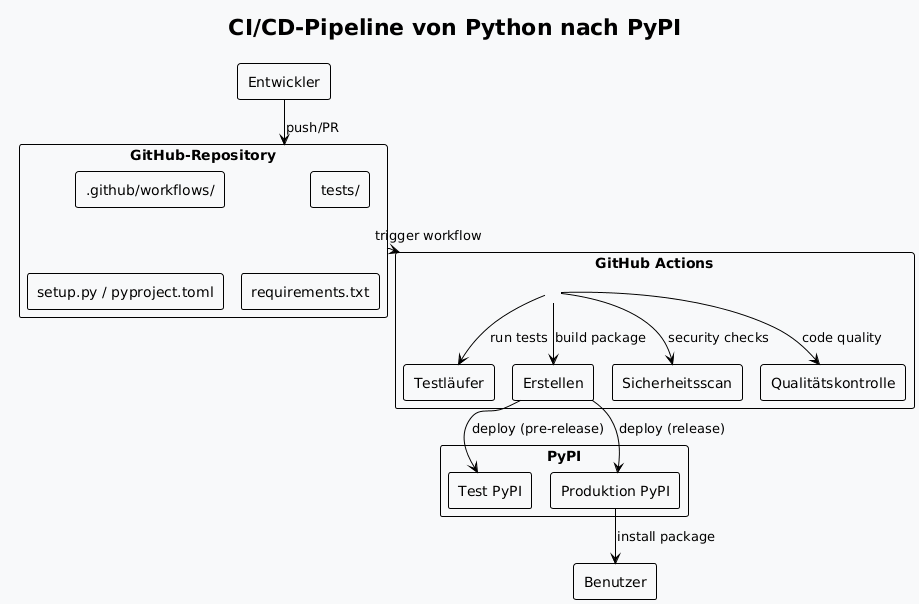
Das Bereitstellen einer Python‑Anwendung auf PyPI erfordert eine robuste CI/CD‑Pipeline, die Tests, den Build und die Veröffentlichung der Pakete automatisiert. Dieser Artikel beschreibt die Einrichtung eines vollständigen Pipelines mit GitHub Actions für eine Python‑CLI‑Anwendung unter Verwendung der Best Practices des modernen Python‑Ökosystems.
Architektur des CI/CD-Pipelines
Der Pipeline, den wir bauen werden, folgt einem mehrstufigen Ansatz:
Projektstruktur
Eine CLI-Python-Anwendung, die für die Verteilung bereit ist, muss einer standardisierten Struktur entsprechen:
playlist-downloader/
├── .github/
│   └── workflows/
│       ├── ci.yml
│       ├── release.yml
│       └── security.yml
├── src/
│   └── playlist_downloader/
│       ├── __init__.py
│       ├── cli.py
│       ├── core/
│       └── adapters/
├── tests/
│   ├── unit/
│   ├── integration/
│   └── conftest.py
├── docs/
├── pyproject.toml
├── requirements.txt
├── requirements-dev.txt
├── MANIFEST.in
├── README.md
├── LICENSE
└── CHANGELOG.md
Konfiguration des Pakets mit pyproject.toml
Die Datei`pyproject.toml`ist der moderne Standard zum Konfigurieren von Python-Paketen:
[build-system]
requires = ["setuptools>=45", "wheel", "setuptools_scm>=6.2"]
build-backend = "setuptools.build_meta"

[project]
name = "playlist-downloader"
authors = [
    {name = "Christophe Hérolivier", email = "[email protected]"},
]
description = "CLI tool for YouTube playlist management"
readme = "README.md"
requires-python = ">=3.8"
keywords = ["youtube", "playlist", "cli", "downloader"]
license = {text = "MIT"}
classifiers = [
    "Development Status :: 4 - Beta",
    "Environment :: Console",
    "Intended Audience :: End Users/Desktop",
    "License :: OSI Approved :: MIT License",
    "Operating System :: OS Independent",
    "Programming Language :: Python :: 3",
    "Programming Language :: Python :: 3.8",
    "Programming Language :: Python :: 3.9",
    "Programming Language :: Python :: 3.10",
    "Programming Language :: Python :: 3.11",
    "Topic :: Multimedia :: Sound/Audio",
    "Topic :: Utilities",
]
dependencies = [
    "typer>=0.9.0",
    "yt-dlp>=2023.7.6",
    "google-api-python-client>=2.0.0",
    "google-auth-oauthlib>=1.0.0",
    "pyyaml>=6.0",
    "rich>=13.0.0",
]
dynamic = ["version"]

[project.optional-dependencies]
dev = [
    "pytest>=7.0.0",
    "pytest-cov>=4.0.0",
    "pytest-mock>=3.10.0",
    "black>=23.0.0",
    "flake8>=6.0.0",
    "mypy>=1.0.0",
    "pre-commit>=3.0.0",
    "tox>=4.0.0",
]
test = [
    "pytest>=7.0.0",
    "pytest-cov>=4.0.0",
    "pytest-mock>=3.10.0",
]

[project.urls]
Homepage = "https://github.com/cheroliv/playlist-downloader"
Documentation = "https://github.com/cheroliv/playlist-downloader#readme"
Repository = "https://github.com/cheroliv/playlist-downloader.git"
"Bug Tracker" = "https://github.com/cheroliv/playlist-downloader/issues"

[project.scripts]
playlist-downloader = "playlist_downloader.cli:main"

[tool.setuptools_scm]
write_to = "src/playlist_downloader/_version.py"

[tool.setuptools.packages.find]
where = ["src"]

[tool.pytest.ini_options]
testpaths = ["tests"]
python_files = ["test_*.py"]
python_classes = ["Test*"]
python_functions = ["test_*"]
addopts = [
    "--cov=src/playlist_downloader",
    "--cov-report=html",
    "--cov-report=term-missing",
    "--cov-fail-under=85",
]

[tool.black]
line-length = 88
target-version = ['py38']
include = '\.pyi?$'
extend-exclude = '''
/(
  \.eggs
  | \.git
  | \.hg
  | \.mypy_cache
  | \.tox
  | \.venv
  | _build
  | buck-out
  | build
  | dist
)/
'''

[tool.mypy]
python_version = "3.8"
warn_return_any = true
warn_unused_configs = true
disallow_untyped_defs = true
disallow_incomplete_defs = true
check_untyped_defs = true
disallow_untyped_decorators = true
no_implicit_optional = true
warn_redundant_casts = true
warn_unused_ignores = true
warn_no_return = true
warn_unreachable = true
strict_equality = true

[[tool.mypy.overrides]]
module = [
    "yt_dlp.*",
    "googleapiclient.*",
    "google_auth_oauthlib.*",
]
ignore_missing_imports = true
CI/CD-Workflow - Tests und Qualität
Der Haupt-Workflow (ci.yml) führt die Tests auf mehreren Python-Versionen durch:
name: CI

on:
  push:
    branches: [ main, develop ]
  pull_request:
    branches: [ main ]

jobs:
  test:
    runs-on: ubuntu-latest
    strategy:
      matrix:
        python-version: ["3.8", "3.9", "3.10", "3.11"]

    steps:
    - uses: actions/checkout@v4
      with:
        fetch-depth: 0

    - name: Set up Python ${{ matrix.python-version }}
      uses: actions/setup-python@v4
      with:
        python-version: ${{ matrix.python-version }}

    - name: Cache dependencies
      uses: actions/cache@v3
      with:
        path: |
          ~/.cache/pip
          ~/.cache/pre-commit
        key: ${{ runner.os }}-pip-${{ hashFiles('**/requirements*.txt') }}
        restore-keys: |
          ${{ runner.os }}-pip-

    - name: Install dependencies
      run: |
        python -m pip install --upgrade pip
        pip install -e ".[dev]"

    - name: Lint with flake8
      run: |
        flake8 src tests --count --select=E9,F63,F7,F82 --show-source --statistics
        flake8 src tests --count --exit-zero --max-complexity=10 --max-line-length=88 --statistics

    - name: Check code formatting with Black
      run: black --check src tests

    - name: Type checking with mypy
      run: mypy src

    - name: Run tests with pytest
      run: |
        pytest tests/ -v --cov=src/playlist_downloader \
          --cov-report=xml --cov-report=term-missing

    - name: Upload coverage to Codecov
      uses: codecov/codecov-action@v3
      if: matrix.python-version == '3.11'
      with:
        file: ./coverage.xml
        flags: unittests
        name: codecov-umbrella

  security:
    runs-on: ubuntu-latest
    steps:
    - uses: actions/checkout@v4

    - name: Set up Python
      uses: actions/setup-python@v4
      with:
        python-version: "3.11"

    - name: Install dependencies
      run: |
        python -m pip install --upgrade pip
        pip install bandit[toml] safety

    - name: Run security checks with bandit
      run: bandit -r src/ -f json -o bandit-report.json

    - name: Check dependencies with safety
      run: safety check --json --output safety-report.json

    - name: Upload security reports
      uses: actions/upload-artifact@v3
      if: always()
      with:
        name: security-reports
        path: |
          bandit-report.json
          safety-report.json

  build:
    needs: [test, security]
    runs-on: ubuntu-latest
    steps:
    - uses: actions/checkout@v4
      with:
        fetch-depth: 0

    - name: Set up Python
      uses: actions/setup-python@v4
      with:
        python-version: "3.11"

    - name: Install build dependencies
      run: |
        python -m pip install --upgrade pip
        pip install build twine

    - name: Build package
      run: python -m build

    - name: Check package with twine
      run: twine check dist/*

    - name: Upload build artifacts
      uses: actions/upload-artifact@v3
      with:
        name: dist
        path: dist/
Release- und Deployments-Workflow
Der Release-Workflow (release.yml) verwaltet die automatische Veröffentlichung auf PyPI :
name: Release

on:
  push:
    tags:
      - 'v*.*.*'
  workflow_dispatch:
    inputs:
      environment:
        description: 'Deployment environment'
        required: true
        default: 'test'
        type: choice
        options:
        - test
        - production

env:
  PYTHON_VERSION: "3.11"

jobs:
  release:
    runs-on: ubuntu-latest
    environment:
      name: ${{ github.event.inputs.environment || (startsWith(github.ref, 'refs/tags/') && 'production' || 'test') }}

    steps:
    - uses: actions/checkout@v4
      with:
        fetch-depth: 0

    - name: Set up Python
      uses: actions/setup-python@v4
      with:
        python-version: ${{ env.PYTHON_VERSION }}

    - name: Install dependencies
      run: |
        python -m pip install --upgrade pip
        pip install build twine

    - name: Build package
      run: python -m build

    - name: Check package
      run: twine check dist/*

    - name: Publish to Test PyPI
      if: github.event.inputs.environment == 'test' || (startsWith(github.ref, 'refs/tags/') && contains(github.ref, 'rc'))
      env:
        TWINE_USERNAME: __token__
        TWINE_PASSWORD: ${{ secrets.TEST_PYPI_API_TOKEN }}
      run: |
        twine upload --repository testpypi dist/*

    - name: Publish to PyPI
      if: github.event.inputs.environment == 'production' || (startsWith(github.ref, 'refs/tags/') && !contains(github.ref, 'rc'))
      env:
        TWINE_USERNAME: __token__
        TWINE_PASSWORD: ${{ secrets.PYPI_API_TOKEN }}
      run: |
        twine upload dist/*

    - name: Create GitHub Release
      if: startsWith(github.ref, 'refs/tags/')
      uses: actions/create-release@v1
      env:
        GITHUB_TOKEN: ${{ secrets.GITHUB_TOKEN }}
      with:
        tag_name: ${{ github.ref }}
        release_name: Release ${{ github.ref }}
        draft: false
        prerelease: ${{ contains(github.ref, 'rc') }}

  post-release:
    needs: release
    runs-on: ubuntu-latest
    if: startsWith(github.ref, 'refs/tags/')

    steps:
    - uses: actions/checkout@v4

    - name: Set up Python
      uses: actions/setup-python@v4
      with:
        python-version: ${{ env.PYTHON_VERSION }}

    - name: Test installation from PyPI
      run: |
        sleep 60  # Attendre la propagation sur PyPI
        pip install playlist-downloader
        playlist-downloader --version

    - name: Update documentation
      run: |
        # Script pour mettre à jour la documentation
        echo "Documentation updated for version ${GITHUB_REF#refs/tags/}"
Diagramme der Architektur
Sequenzdiagramm - Release-Prozess
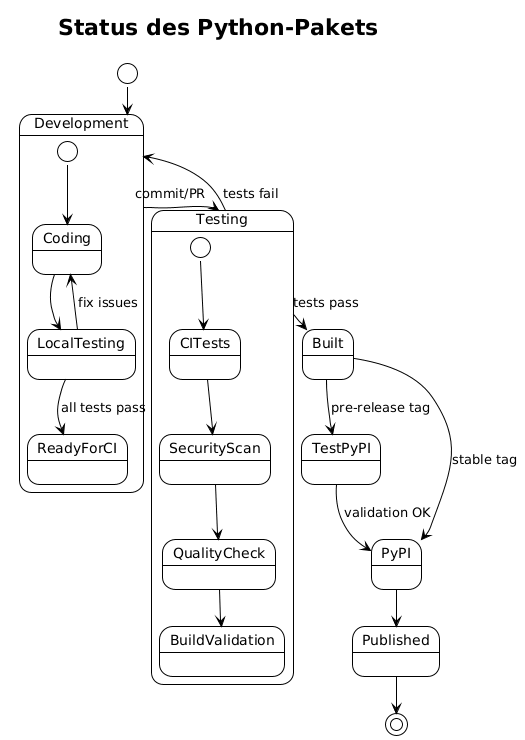
Zustandsdiagramm - Paketlebenszyklus
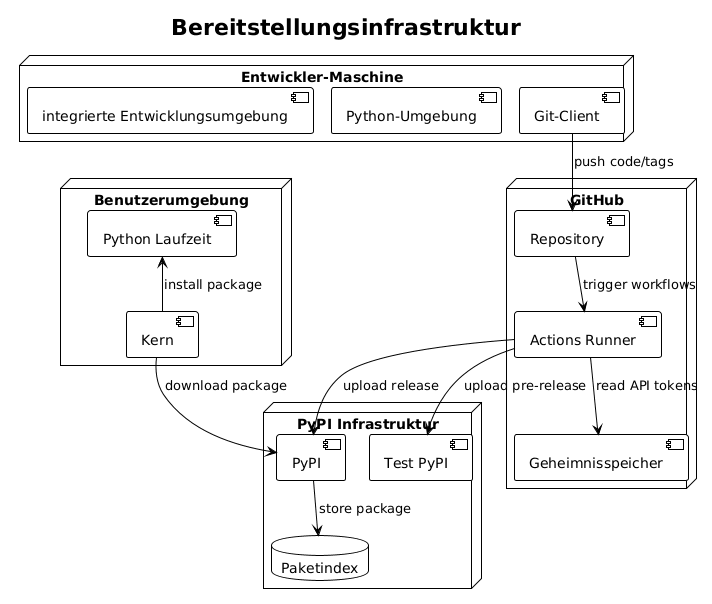
Bereitstellungsdiagramm - CI/CD-Infrastruktur
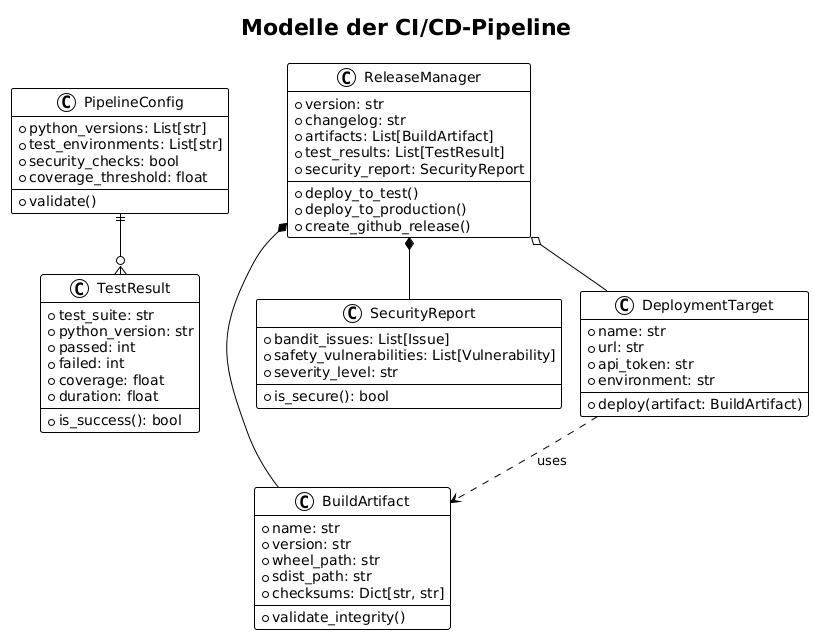
Objekte und Modelle der Pipeline
Klassendiagramm - CI/CD-Modelle
Konfiguration der Geheimnisse
Damit die Pipeline funktioniert, müssen Sie die folgenden Geheimnisse in GitHub konfigurieren:
Geheimnisse GitHub Actions
# Dans Settings > Secrets and variables > Actions

# Token PyPI pour la production
PYPI_API_TOKEN=pypi-...

# Token Test PyPI pour les pré-releases
TEST_PYPI_API_TOKEN=pypi-...

# Token GitHub pour créer les releases
GITHUB_TOKEN=(automatiquement fourni)

# Token Codecov (optionnel)
CODECOV_TOKEN=...
Generierung der PyPI-Tokens
# 1. Créer un compte sur PyPI et Test PyPI
# 2. Aller dans Account Settings > API tokens
# 3. Créer un token avec scope "Entire account" ou spécifique au projet
# 4. Format du token : pypi-AgEIcHlwaS5vcmc...
Lokale Entwicklungs-Skripte
Um die Entwicklung zu erleichtern, erstellen Sie Hilfsskripte:
Makefile
.PHONY: install test lint format security build clean release-test release-prod

install:
	pip install -e ".[dev]"

test:
	pytest tests/ -v --cov=src/playlist_downloader

lint:
	flake8 src tests
	mypy src

format:
	black src tests

security:
	bandit -r src/
	safety check

build:
	python -m build
	twine check dist/*

clean:
	rm -rf build/ dist/ *.egg-info/
	find . -type d -name __pycache__ -delete
	find . -name "*.pyc" -delete

release-test: clean build
	twine upload --repository testpypi dist/*

release-prod: clean build
	twine upload dist/*

pre-commit: format lint test security
	@echo "✅ Prêt pour commit"
Versionsskript
#!/usr/bin/env python3
"""Script pour gérer les versions du projet."""

import sys
import subprocess
from pathlib import Path

def get_current_version():
    """Récupère la version actuelle depuis git."""
    try:
        result = subprocess.run(
            ["git", "describe", "--tags", "--abbrev=0"],
            capture_output=True,
            text=True,
            check=True
        )
        return result.stdout.strip()
    except subprocess.CalledProcessError:
        return "0.0.0"

def create_version_tag(version, message=None):
    """Crée un tag de version."""
    if not version.startswith('v'):
        version = f'v{version}'

    tag_message = message or f"Release {version}"

    subprocess.run(["git", "tag", "-a", version, "-m", tag_message], check=True)
    print(f"✅ Tag {version} créé")

    # Push le tag
    subprocess.run(["git", "push", "origin", version], check=True)
    print(f"✅ Tag {version} poussé vers origin")

if __name__ == "__main__":
    if len(sys.argv) < 2:
        current = get_current_version()
        print(f"Version actuelle: {current}")
        print("Usage: python version.py <new_version> [message]")
        sys.exit(1)

    new_version = sys.argv[1]
    message = sys.argv[2] if len(sys.argv) > 2 else None

    create_version_tag(new_version, message)
Gute Praktiken und Empfehlungen
Semantisches Versioning
Verwenden Sie die semantische Versionierung (SemVer):
-
MAJOR.MINOR.PATCH(ex: 1.2.3) -
`MAJOR`inkompatible Änderungen
-
MINOR: neue kompatible Funktionen -
`PATCH`kompatible Fehlerbehebungen
Branching-Strategie
main          ──●──●──●──●──●────●── (releases stables)
               /       /          /
develop    ──●──●──●──●──●──●──●──●── (développement)
            /     /        /
feature/xxx  ●──●──●──●──●──/ (fonctionnalités)
Tests und Abdeckung
-
Minimale Codeabdeckung: 85%
-
Einheitstests für die Geschäftslogik
-
Integrations-Tests für die Adapter
-
End-to-End-Tests für die CLI
Sicherheit
-
Automatischer Abhängigkeitsscan (Safety)
-
Statische Codeanalyse (Bandit)
-
Geheimnisse nie im Code
-
Verwendung von spezifischen PyPI-Token
Monitoring und Observabilität
Pipeline-Metriken
# .github/workflows/metrics.yml
name: Pipeline Metrics

on:
  workflow_run:
    workflows: ["CI", "Release"]
    types: [completed]

jobs:
  metrics:
    runs-on: ubuntu-latest
    steps:
    - name: Collect metrics
      run: |
        echo "Pipeline: ${{ github.event.workflow_run.name }}"
        echo "Status: ${{ github.event.workflow_run.conclusion }}"
        echo "Duration: ${{ github.event.workflow_run.updated_at - github.event.workflow_run.created_at }}"
        # Envoyer vers système de monitoring
Benachrichtigungen
# Ajout dans les workflows pour notifications
- name: Notify on failure
  if: failure()
  uses: 8398a7/action-slack@v3
  with:
    status: failure
    text: "❌ Pipeline failed for ${{ github.repository }}"
  env:
    SLACK_WEBHOOK_URL: ${{ secrets.SLACK_WEBHOOK }}
Fazit
Dieser vollständige CI/CD-Pipeline für Python bietet:
-
vollständige Automatisierung: von der Validierung des Codes zur Veröffentlichung
-
Sicherheit: automatische Scans und sichere Verwaltung der Geheimnisse
-
Qualität: Tests mehrerer Versionen, Linting und Codeabdeckung
-
Zuverlässigkeit: schrittweise Bereitstellung über Test PyPI
-
Nachverfolgbarkeit: artifacts, Berichte und releases GitHub
Die Annahme dieser Praktiken gewährleistet einen robusten und professionellen Bereitstellungsprozess für Ihre Python-CLI-Anwendungen, wodurch die Wartung und Weiterentwicklung Ihrer Projekte langfristig erleichtert wird.